
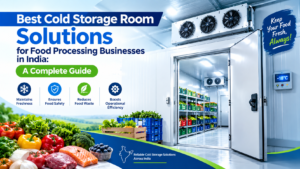
1-Minute Summary: Selecting the right industrial refrigeration system is essential to safeguard food quality, meet FSSAI regulatory standards, and eliminate post-processing spoilage. This comprehensive guide covers walk-in chillers, deep freezer rooms, blast freezers, and modular storage configurations tailored for food processing plants. Learn how to calculate cooling loads based on daily throughput, maintain strict temperature monitoring, and optimize panel insulation to reduce energy overheads. Explore site setup factors for operations in Bangalore and nearby regions like Kalkere, and discover how to evaluate commercial installation estimates.
Quick Consultation: Planning a new cold room or upgrading your existing facility? Discuss your custom cooling and installation requirements directly with Cold Smith Enterprises at +91 98765 43210.
Table of Contents
-
Introduction
-
What Are the Best Cold Storage Room Solutions for Food Processing Businesses?
-
What Temperature Is Required for Different Food Products in Cold Storage?
-
How Does a Cold Room Prevent Food Spoilage?
-
How Do You Choose the Right Cold Storage Capacity for a Food Processing Plant?
-
What Is the Cold Room Installation Cost for Food Processing Businesses in India?
-
How Can Food Manufacturers Reduce Cold Room Energy and Maintenance Costs?
-
How Do You Choose a Reliable Cold Room Supplier in Bangalore?
-
What Should Food Processing Businesses in Kalkere and Bangalore Consider Before Installation?
-
Frequently Asked Questions About Food Processing Cold Rooms
-
Conclusion
1. Introduction
Is your food processing business losing product quality because your current storage system cannot maintain the required temperature?
For any factory owner, plant manager, engineering manager, maintenance manager, service manager, restaurant owner, executive chef, or procurement manager, maintaining thermal control across the supply chain is critical. In unsuitable storage conditions, temperature fluctuations, poor polyurethane foam (PUF) insulation, and incorrect capacity planning create severe operational bottlenecks. Uncontrolled humidity and thermal spikes degrade fresh produce, break the cold chain for processed meats, and lead to costly product rejections.
Implementing the right cold storage room solutions for food processing businesses in India is the primary defense against perishability. The exact system required depends heavily on the incoming thermal load, product chemistry, storage duration, and ambient operating conditions. This guide breaks down equipment selection, temperature compliance, heat-load planning, energy efficiency, and commercial installation dynamics.
Whether you are expanding operations or establishing a facility in areas such as Bangalore, Cold Smith Enterprises provides industrial cold storage solutions tailored to your operational workflow.
Planning a new cold room or upgrading your existing facility? Discuss your requirements with Cold Smith Enterprises today at +91 98765 43210.
2. What Are the Best Cold Storage Room Solutions for Food Processing Businesses?
Food processing plants should select industrial cold storage solutions based on product type, incoming pull-down requirements, and daily workflow rather than initial purchase price alone. Deploying an improper refrigeration configuration leads to excessive power usage, premature compressor wear, and inventory loss.
Types of Industrial Cold Room Systems
| System type | Temperature range | Common applications |
|---|---|---|
| Chiller Room | +2°C to +8°C | Fresh produce, dairy products, beverages, and short-term chilled storage |
| Freezer Room | −18°C to −25°C | Frozen meat, ice cream, and pre-packed ready-to-eat foods |
| Blast Chiller / Freezer | −30°C to −40°C air temperature | Rapid cooling or freezing of freshly cooked and processed food products |
Which Cold Room Type Is Right for Your Business?
-
Chiller Room: Designed for holding products between +2°C and +8°C. Ideal for raw vegetables, dairy, beverages, and short-term holding of fresh produce.
-
Freezer Room: Engineered to operate between -18°C and -25°C. Essential for long-term storage of frozen poultry, meat, seafood, ice creams, and ready-to-eat meals.
-
Blast Chiller or Blast Freezer: High-velocity air systems operating down to -35°C or -40°C. Rapidly pulls down the core temperature of hot or freshly processed foods, preventing micro-structural ice crystal damage and bacterial proliferation.
-
Modular Cold Room / Walk-in Cold Room: Configured with pre-fabricated tongue-and-groove PUF panels. Offers flexibility for future expansion and easy re-configuration inside an existing walk-in cold room footprint.
-
Food Processing Cold Storage Facility: Large-scale industrial cold room setups integrating controlled atmosphere (CA) systems and multi-temperature staging zones.
These food processing cold room systems serve distinct operational roles and are not inter-changeable without compromising safety standards.
3. What Temperature Is Required for Different Food Products in Cold Storage?
Maintaining accurate temperature-controlled food storage requires strict adherence to food safety standards. Storage parameters depend on the raw material’s physical state, packaging type, ambient exposure, and designated shelf-life goals.
Per FSSAI guidance, chilled meat must be maintained at or below 4°C for short-term handling (2–4 days), whereas long-term frozen meat storage requires a sustained temperature of -18°C or lower. Applying these limits indiscriminately across distinct categories like fresh produce or dairy can result in chilling injury or unwanted freezing.
1. CHILLED FRESH MEAT & POULTRY
Target Storage Temperature: 0°C to 4°C
Recommended Guideline: Maintain at or below 4°C for short-term storage (2–4 days).
2. FROZEN MEAT & SEAFOOD
Target Storage Temperature: −18°C or lower
Recommended Guideline: Maintain at or below −18°C for long-term storage (up to 12 months).
3. FRESH FRUITS & VEGETABLES
Target Storage Temperature: +2°C to +8°C (varies by crop)
Recommended Guideline: Maintain humidity levels of 85–95% RH to prevent moisture loss.
4. DAIRY PRODUCTS (MILK, CHEESE)
Target Storage Temperature: +2°C to +5°C
Recommended Guideline: Maintain continuous chilling below 5°C to slow bacterial growth.
5. ICE CREAM & FROZEN DESSERTS
Target Storage Temperature: −22°C to −25°C
Recommended Guideline: Deep-freeze storage helps maintain texture and prevent ice recrystallization.
How Can You Maintain Consistent Storage Temperatures?
Achieving precise temperature stability requires a combination of continuous monitoring and active maintenance:
-
Calibrated Digital Sensors: Install multi-point NTC or PT100 temperature sensors at return-air and supply-air ducts.
-
Automated Alarm Systems: Set up real-time audio-visual alarms and SMS alerts for thermal spikes exceeding set thresholds.
-
Airflow Optimization: Ensure evaporator fan static pressure is sufficient to distribute air evenly through high-density racking.
-
Documented Logs: Maintain automated digital temperature logging systems to fulfill mandatory HACCP and FSSAI audits.
4. How Does A Cold Room Prevent Food Spoilage?
A properly designed food preservation system slows down enzymatic activity and retards micro-organism growth. Refrigeration does not sterilize food or repair pre-existing decay; it holds microbial activity in check to prolong shelf life. Effective cold chain management depends on maintaining unbroken thermal limits from arrival to distribution.
COMMON COLD ROOM OPERATIONAL ERRORS
1. Overloading Racking: Restricts internal airflow circulation and causes uneven cooling.
2. Loading Warm Batches: Exceeds the plant’s pull-down cooling capacity.
3. Leaving Doors Ajar: Allows warm, moist air to enter, causing severe frost build-up on evaporators.
4. Mixing Incompatible Products: Increases cross-contamination risks and causes temperature mismatches.
Critical Operational Pitfalls to Avoid:
-
Overloading Air Pathways: Stacking pallets directly against walls or evaporator outlets blocks air distribution.
-
Bypassing Pre-Cooling: Placing hot or unchilled products into standard holding rooms overloads the compressors.
-
Door Mismanagement: Prolonged door openings cause moisture ingress, leading to heavy evaporator coil icing and temperature spikes.
-
Cross-Contamination: Storing raw meats alongside ready-to-eat produce risks microbial transfer and odours.
5. How Do You Choose the Right Cold Storage Capacity for a Food Processing Plant?
Sizing a cold storage facility requires precise refrigeration capacity calculations based on total heat load, rather than relying solely on room volume.
COLD STORAGE HEAT LOAD CALCULATION FACTORS
1. Product Load: Kg/day + Incoming Temperature + Target Temperature
2. Structural Heat Loss: PUF Panel Thickness + Surface Area
3. Internal Heat Gain: Lighting + Motors + Personnel
4. Infiltration Load: Door Opening Frequency + Air Curtains
What Should You Calculate Before Installing a Cold Room?
Before requesting a commercial proposal, gather these key operational parameters:
-
Product Throughput: Total weight ($\text{kg}$) loaded per batch and expected daily turnover rate.
-
Temperature Differential ($\Delta T$): The difference between the incoming product temperature and the target holding setpoint.
-
Required Pull-Down Time: The hours allowed to cool incoming stock down to setpoint temperature.
-
Structural Dimensions: Available floor space, ceiling height clearances, pallet racking layouts, and forklift access lanes.
-
Thermal Envelope: Thickness of PUF insulation panels (e.g., 60 mm, 80 mm, 100 mm, or 150 mm).
-
Operational Ingress: Daily door opening frequencies, strip curtain usage, and anteroom air-lock provisions.
Engaging in detailed cold room design for food processing ensures that condensing units and evaporator coils are correctly sized to match peak operational demands.
6. What Is the Cold Room Installation Cost for Food Processing Businesses in India?
There is no fixed price for commercial cold storage because costs vary depending on capacity, target temperature, and site conditions. In the Indian market, turnkey installation costs generally fall into predictable ranges based on facility scale:
-
Small Commercial Cold Rooms (50 to 100 MT): Typical investments range between ₹10 Lakhs and ₹15 Lakhs.
-
Medium Processing Facilities (1,000 MT): Construction and machinery costs range from ₹1,800 to ₹3,500 per sq. ft. (approx. ₹4.8 Crores to ₹7 Crores overall depending on whether it is a chiller or deep freezer room).
Key Factors Impacting Cold Storage Cost in India:
-
Operating Temperature Limits: Deep freezer systems (-25°C) require thicker insulation panels and two-stage compressors, increasing costs by 30% to 50% compared to standard positive chillers (+4°C).
-
Insulation Specifications: High-density (40 kg/m³) PUF panels with food-grade SS304 or pre-painted galvanized steel (PPGS) sheet cladding directly affect the initial budget.
-
Refrigeration Equipment: High-efficiency scroll, reciprocating, or screw compressor packages (e.g., Bitzer, Copeland, Danfoss) add to upfront capital expenses but lower long-term operating costs.
-
Civil & Floor Insulation: Heavy-duty floor insulation using XPS board with concrete screed and anti-hearth heaters for freezer rooms.
Always request an itemized quotation covering civil works, panel envelopes, refrigeration machinery, panel electrical boards, and commissioning services.
Need a precise estimate? Request a custom project quotation tailored to your operational parameters from Cold Smith Enterprises.
7. How Can Food Manufacturers Reduce Cold Room Energy and Maintenance Costs?
Energy consumption accounts for a significant portion of a cold plant’s operational expenditure. Implementing structured preventive cold room maintenance reduces power usage while extending equipment service life.
ENERGY EFFICIENCY CHECKLIST FOR PLANT MANAGERS
1. Inspect door magnetic gaskets and thermal perimeter seals.
2. De-scale condenser coils and clean evaporator fins monthly.
3. Calibrate expansion valves and verify refrigerant charge.
4. Install PVC strip curtains and automatic door closers.
5. Program automated defrost cycles during off-peak power hours.
Best Practices to Improve Cold Room Efficiency:
-
Maintain Thermal Integrity: Inspect wall-to-wall panel joints and floor flashings for thermal leakage or condensation.
-
Clean Heat Exchangers Regularly: Dirty air-cooled condensers increase discharge pressure, causing compressors to draw excessive current.
-
Install Air Curtains: Minimize warm air infiltration during loading and unloading with PVC strip curtains or high-velocity air barriers.
-
Optimize Defrost Schedules: Use demand-based electric or hot-gas defrost systems instead of fixed timer-based cycles.
-
Schedule Preventive Servicing: Partner with qualified refrigeration technicians to regularly check oil levels, electrical contactors, and refrigerant levels.
8. How Do You Choose a Reliable Cold Room Supplier in Bangalore?
Selecting an experienced manufacturer is critical to ensuring your cold storage installation runs smoothly and reliably.
Checklist for Evaluating Cold Room Manufacturers:
-
Technical Expertise: Proven experience designing systems tailored to specific food segments (meat, dairy, fruits, bakery, or ready-to-eat).
-
Quality Compliance: Use of non-CFC, high-density PUF panels conforming to fire safety and hygiene requirements.
-
Clear Scope of Work: Quotations that explicitly specify panel thickness, cladding metal gauges, compressor horsepower, heat load design conditions, and warranty terms.
-
After-Sales Support: Local availability of emergency repair services, genuine spare parts, and routine maintenance contracts.
Cold Smith Enterprises offers industrial cold storage solutions across Bangalore, delivering engineered cold storage systems backed by clear technical specifications and responsive service support.
9. What Should Food Processing Businesses in Kalkere and Bangalore Consider Before Installation?
Setting up a cold room facility in industrial hubs like Bangalore and nearby areas such as Kalkere requires careful site preparation to avoid installation delays.
SITE READINESS CHECKLIST
1. Electrical Power: Check the sanctioned electrical load and install a backup diesel generator (DG).
2. Ventilation: Ensure adequate airflow around outdoor condensing units.
3. Civil Floor: Verify that the concrete slab flooring is level and properly prepared.
4. Logistics Access: Confirm truck turning radius and dock loading height.
5. Drainage: Route insulated drain lines from evaporator coils to suitable drainage points.
Key Site Planning Requirements:
-
Power Supply & Backup: Verify adequate 3-phase power load and install dedicated diesel generator (DG) backup systems to protect against power outages.
-
Condenser Placement: Ensure outdoor condensing units are positioned in well-ventilated areas away from direct sunlight and heat pockets.
-
Floor Levelling: Prepare a flat concrete sub-base to support panel alignment, heavy pallet loads, and sub-floor insulation.
-
Drainage Infrastructure: Install dedicated, trapped condensate drain lines with heater cables for freezer rooms to prevent ice accumulation.
10. Frequently Asked Questions About Food Processing Cold Rooms
What is the best cold storage room for a food processing business?
The optimal system depends on your specific product type, target processing temperatures, loading volume, and workflow. Walk-in chillers suit fresh foods (+2°C to +8°C), freezer rooms preserve frozen stock (-18°C), and blast freezers handle rapid batch cooling.
What temperature should a food processing cold room maintain?
Temperatures vary by product. FSSAI mandates chilled meats stay at or below 4°C and frozen meats at or below -18°C. Dairy items typically require +2°C to +5°C, while fresh produce ranges from +2°C to +8°C depending on humidity requirements.
How much does cold room installation cost in India?
Installation costs depend on room dimensions, required temperature ranges, panel specifications, and refrigeration capacity. Small units start around ₹10 Lakhs, while commercial plants range between ₹1,800 and ₹3,500 per sq. ft. Request an itemized site quotation for accurate pricing.
How do you calculate cold storage capacity for a factory?
Calculate total daily product intake, incoming vs. target temperatures, pull-down time, room dimensions, racking layout, door openings, and ambient heat exposure. A qualified refrigeration engineer uses these parameters to determine the total cooling capacity .
How can a food processing business reduce cold room power consumption?
Keep PUF panels and door gaskets in good repair, clear condenser coils, install PVC strip curtains, avoid room overloading, and run preventive maintenance checks on compressors and refrigerant levels.
Can Cold Smith Enterprises help with cold room requirements in Bangalore?
Yes. Cold Smith Enterprises designs, supplies, installs, and services commercial cold storage rooms, blast freezers, and industrial refrigeration systems in Bangalore and surrounding regions like Kalkere. Contact their technical team to discuss project-specific requirements.
11. Conclusion
Selecting the right cold storage room solution is a critical business decision that protects food quality, ensures FSSAI compliance, and minimizes operational overhead. By carefully evaluating your thermal load, selecting appropriate PUF panel specifications, maintaining correct airflow, and keeping up with preventive maintenance, your facility can eliminate unnecessary product losses.
Take the next step in optimizing your cold chain infrastructure by evaluating your current refrigeration capabilities or consulting with local industry specialists.
Ready to upgrade or build your cold room facility?
Contact Cold Smith Enterprises today to discuss your project requirements, request a site assessment, or get a detailed custom quotation.
Direct Line: +91 98765 43210
Service Coverage: Bangalore, Kalkere, and nearby industrial regions.